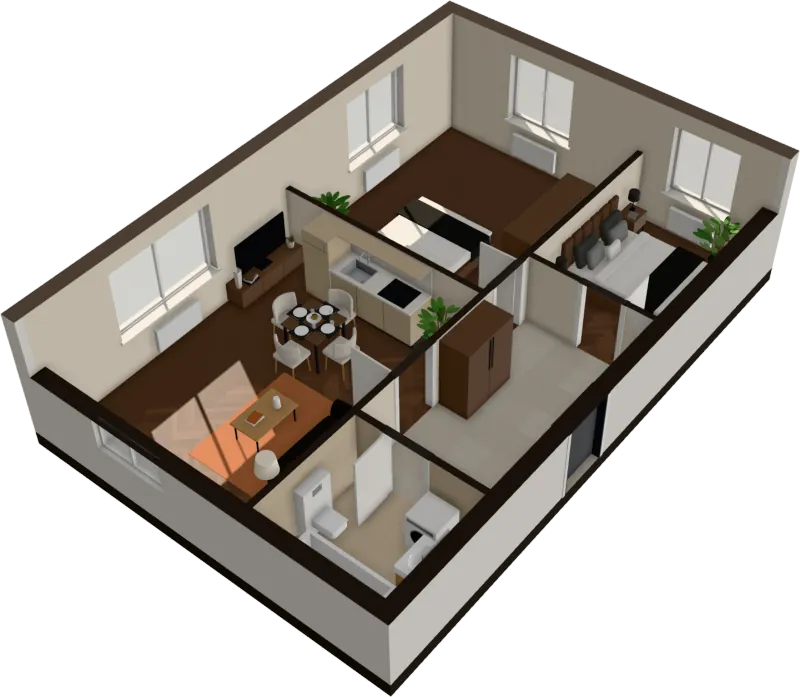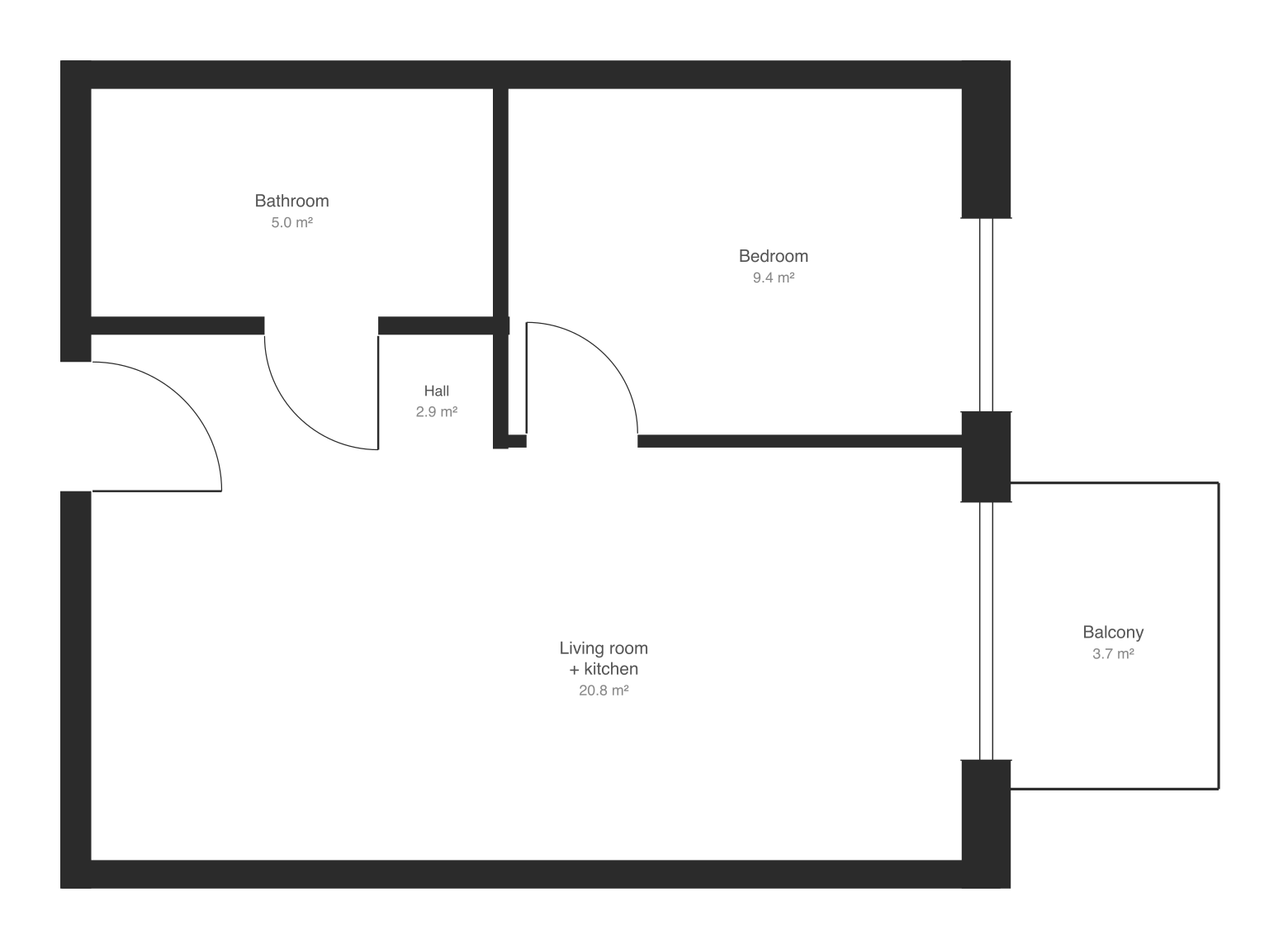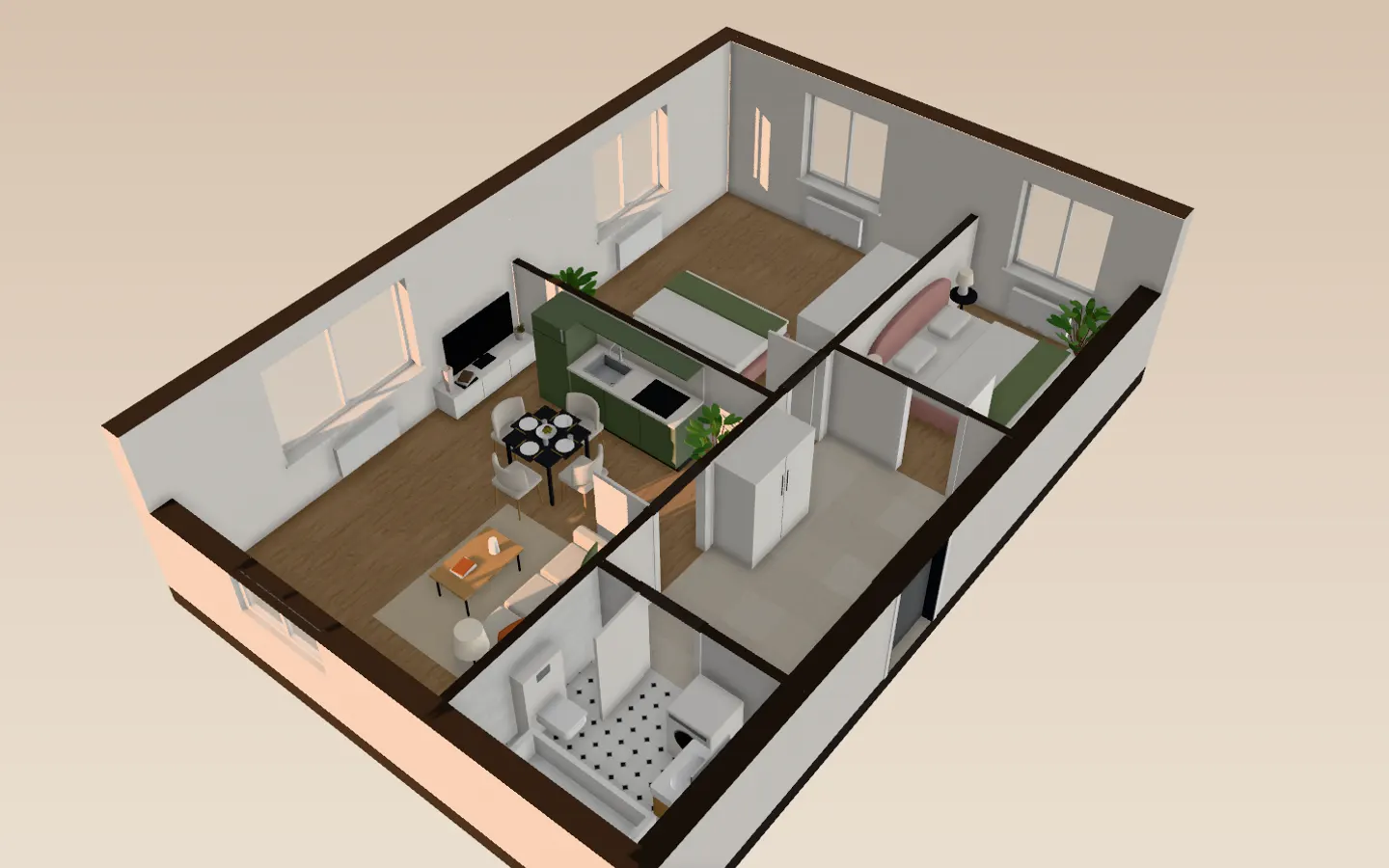
A floor plan tells you which way every window faces, as long as you know where north is. Once you do, you can tell from the drawing which rooms get morning sun, which get the evening, and which get none at all in winter. It is one of the few things about an apartment you can’t change after you move in, so decide which way your apartment should face before you sign.
The short answer: in a cool climate such as the UK, Poland or northern Europe, you want the living room on the south, south-east or south-west side of the plan and bedrooms on the east or north side. In a hot climate such as Dubai or southern Spain, the priorities flip: north is the comfortable side and west is the one to avoid.
Everything below is for the northern hemisphere. South of the equator, swap north and south.
Find north on the plan
- The north arrow. Many developer and architect plans have a small arrow or compass rose marked N. It is often in a corner, next to the scale bar or the legend.
- The site plan. A new-construction brochure usually has a site or floor plate plan showing the whole building with a north arrow. Find your apartment on it and carry the direction across. Check the apartment plan isn’t drawn rotated compared with the site plan: developers often turn each apartment so its front door is at the bottom.
- No arrow at all. Most agents’ plans leave it out. Find the building on an online map in satellite view, with north at the top. Work out which side has the apartment’s windows or balconies (street-level photos help), then match that side to the plan.
- The listing wording. “South-facing” in a UK listing often describes the garden or the balcony, not the living room. Ask which rooms the main windows are in.
- A compass at the viewing. Stand at the main window, face out and read your phone’s compass. Keep it away from radiators and steel window frames, which throw it off.
A sun path website such as SunCalc shows the sunrise and sunset directions over a map for any date, so you can check your reading against the building itself. For new homes, UK planning applications often include a daylight and sunlight report, and Polish designs have to meet the national sunlight rule, so the developer or the council’s planning register can tell you too. For everything else on the drawing, see how to read a floor plan.
Work out which way each window faces
A window faces the direction you would look if you stood in the room and looked straight out through it, at right angles to the wall. On a plan with north at the top:
- windows in the top outer wall face north,
- windows in the bottom outer wall face south,
- windows in the right outer wall face east,
- windows in the left outer wall face west.
If the north arrow points somewhere else, turn the plan (or your head) until it points up, then read the walls again. An arrow pointing to the top-right means the top wall faces north-east, the right wall south-east, and so on.
Go around the plan and write a direction next to every window and balcony door. Then note three things:
- Rooms with windows in two outer walls. A corner room gets the sun of both directions.
- Windows onto a balcony or loggia. A balcony above, or a loggia recessed into the building, shades the window behind it. Its depth, drawn on the plan, tells you how much.
- Rooms with no outside window at all. Bathrooms and walk-in wardrobes often have none, which is fine. A “bedroom” with no window, or one that borrows light from another room, is not.
Worked example. A one-bedroom plan has its north arrow pointing straight up. The living room and its balcony door are on the bottom wall, so they face south. The bedroom window is on the right wall, facing east. The kitchen window is on the top wall, facing north. From the drawing alone you know the living room gets sun all winter day, the bedroom gets morning sun, and the kitchen gets soft, even light with sun only on summer mornings and evenings. That is close to an ideal layout for London or Warsaw.
How the sun moves through the year
The sun rises due east and sets due west only at the equinoxes, around March 20 and September 22. In summer it rises in the north-east, climbs high across the south and sets in the north-west. In winter it rises in the south-east, stays low and sets in the south-west. At midday it is always due south (outside the tropics).
So in summer the sun touches almost every wall of a building, even the north one, early and late in the day. In winter only the southern half of the plan gets any sun.
How high the sun climbs depends on how far you are from the equator:
| City | Noon sun, 21 Dec | Noon sun, 21 Jun | Daylight, 21 Dec | Daylight, 21 Jun |
|---|---|---|---|---|
| Warsaw (52° N) | 14° | 61° | 7 h 40 min | 16 h 50 min |
| London (51.5° N) | 15° | 62° | 7 h 50 min | 16 h 40 min |
| Madrid (40° N) | 26° | 73° | 9 h 20 min | 15 h 05 min |
| Dubai (25° N) | 41° | 88° | 10 h 35 min | 13 h 40 min |
In London and Warsaw the winter sun is low and short, so a south-facing room is prized. In Dubai the summer sun at noon is almost overhead, so it hits the roof rather than a south window, and the low morning and evening sun on east and west walls matters more.
South of the equator the picture is mirrored: in Sydney or Cape Town, north-facing rooms get the winter sun and south-facing rooms get none. East still means morning and west still means evening.
Hours of sun by direction
This is roughly how many hours the sun can shine on a window facing each way in London or Warsaw (the two are almost identical), on a clear day with nothing in the way. The figure in brackets counts only the hours with the sun more than 10° above the horizon. Lower sun is weak and usually blocked by the buildings opposite.
| Window faces | December 21 | March 20 | June 21 |
|---|---|---|---|
| South | 7.6 h (4.1 h) | 12 h (9.8 h) | 9.3 h (9.3 h) |
| South-east or south-west | 7.2 h (4.1 h) | 8.5 h (7.5 h) | 10 h (8.7 h) |
| East or west | 3.8 h (2 h) | 6 h (4.9 h) | 8.3 h (7 h) |
| North-east or north-west | 0.4 h (0) | 3.5 h (2.4 h) | 6.5 h (5.2 h) |
| North | 0 | 0 | 7.2 h (4.5 h) |
Calculated from the sun’s position at 51.5–52° N. Clouds, buildings, trees and balconies all take their share.
A south-facing window gets sun for the whole of a short winter day, while a north-facing one gets none from late September to mid-March. In midsummer, south-east and south-west windows get more hours than south, because the high noon sun hits a south wall at a steep angle.
What each direction means for the room behind it
South
Sun: all day in winter and at the equinoxes, low and deep into the room. In summer, from mid-morning to late afternoon, high in the sky, so a balcony above shades it. Best for: living rooms, eat-in kitchens, plants. Watch for: glare on a TV or screen at midday. In Madrid or Dubai, heat in spring and fall unless the window is shaded.
South-west
Sun: late morning to sunset, all year. In London in June, from about 11:20 am until sunset, after 9 pm. Best for: living rooms and balconies for people out during the day. Watch for: summer heat that builds through the afternoon, especially on upper floors with big windows.
West
Sun: from noon to sunset: short and low in winter, long, low and hot in summer. Best for: a living room or balcony used in the evening. Watch for: bedrooms that are still warm at bedtime. Low sun comes in under any balcony above, and the simple method in England’s overheating rules for new homes (Approved Document O) allows the least glass where the main glazed wall faces west or south.
North-west
Sun: none in winter, some late afternoon sun in spring and fall, and golden evening sun in summer. Best for: bedrooms, studies, kitchens used in the evening. Watch for: a living room with no sun for four months of the year.
North
Sun: none from the fall to the spring equinox. In summer, a little very early and very late (before about 8:20 am and after about 5:40 pm in London in June). Best for: home offices, studios, bedrooms, kitchens, and almost any room in a hot climate. The light is soft and even all day and the room never overheats. Watch for: an apartment whose every window faces north. In the UK or Poland no room would get winter sun, and cold outer walls make condensation more likely without good ventilation.
North-east
Sun: none in winter, early morning in spring and fall, sunrise to late morning in summer. Best for: bedrooms, bathrooms, home offices. Watch for: a living room that feels gloomy on winter afternoons.
East
Sun: sunrise to noon, all year: a short, low spell in winter, from about 4:45 am in London in June. Best for: bedrooms (with blackout blinds for summer), kitchens, a breakfast table. Watch for: a living room already in shade when you get home.
South-east
Sun: almost all day in winter; sunrise to about 3 pm in summer. Best for: living rooms, kitchens, home offices. It gives morning sun, most of south’s winter warmth, and a cooler late afternoon, and is one of the most comfortable directions for a whole apartment. Watch for: a balcony that gets sun at breakfast but not at dinner.
Is each room on the right side?
With a direction on every window, check that the rooms sit on the side that suits them. For cool and temperate climates:
| Room | Best | Fine | Avoid if you can |
|---|---|---|---|
| Living room | South, south-east, south-west | West | North, if it’s the only aspect |
| Kitchen | East, south-east, north | North-east, north-west | West (cooking heat plus evening sun) |
| Bedroom | East, north-east, north | South-east | West, south-west (warm at bedtime) |
| Home office | North, north-east | East, south-east | West, south-west (low sun on screens) |
| Bathroom | Any | Any | Nothing to avoid |
| Balcony | South, south-west, west | South-east | North (sun only on summer evenings) |
If a plan can’t give every room its best side, give the sun to the living room and the cool side to the bedroom. You spend daylight in one and the night in the other.
The plan shows more than direction:
- Window width against room depth. Sun and daylight reach only so far into a room. A common rule of thumb is that a room stays well lit to a depth of about twice the height of the top of the window, so roughly 13–16 ft in an apartment with ordinary ceilings. A 23 ft deep living room with one window at the narrow end will be dark at the back whichever way it faces.
- Balcony and loggia depth. A 5–6½ ft deep balcony above a south window blocks the high summer sun but lets the low winter sun in. The same balcony on a west window does little, because the evening sun comes in low underneath it.
- Which rooms share the sunny wall. In many new-construction apartments the living room and one bedroom share the best wall and the other rooms face a courtyard or the corridor side. Count how much of the sunny wall goes to rooms you use by day.
Dual-aspect and corner apartments
Look at how many outer walls have windows. A single-aspect apartment has windows on one wall only, a dual-aspect apartment on two opposite walls, and a corner apartment on two adjacent walls. You can see this at a glance on the plan, and it matters more than any single direction.
- Light at two times of day. An east–west apartment gets morning sun on one side and evening sun on the other. A south-and-east corner apartment gets sun from sunrise to mid-afternoon.
- Air through the apartment. Windows on two sides clear heat on a summer night far faster than windows on one. England’s overheating rules treat cross-ventilated homes more generously for this reason.
- A choice of rooms. Living room on the sunny side, bedroom on the cool side.
A north–south through apartment is one of the best layouts in a cool climate: sun in the living room, a quiet, cool bedroom. A single-aspect north-facing apartment is the one to think hardest about in the UK or Poland. Poland’s 2002 technical conditions, which most apartments on sale were designed to, require at least one room of a multi-room apartment to get 3 hours of sun between 7 am and 5 pm on the equinoxes (1.5 hours in inner-city areas). A new regulation that counts the hours around solar noon instead has been in preparation, so ask which rules a project was designed under. The UK’s BRE daylight guide (BR 209, 2022) recommends that new homes with a main window wall facing within 90° of due south have at least one room, preferably the living room, with 1.5 hours of sun on March 21.
Hot climates: read the plan the other way around
In Dubai, the Gulf or southern Spain, the plan check flips. You are looking for rooms that keep the sun out.
- West-facing living rooms with big glass are the warning sign. They take low, direct sun through the hottest hours of the day, and the apartment stays hot into the night.
- East and west walls get more summer sun than south. In Dubai in June a south window gets direct sun for only about 3 hours, at a steep angle a balcony above can block. East and west windows get 6 to 7 hours of low sun that no overhang stops.
- North is the comfortable side. A north window in Dubai gets no sun in winter. In summer it gets low sun early and late, and for the rest of the day the sun is so high that it only grazes the wall.
- Shade drawn on the plan counts. A deep balcony or loggia in front of the living room is worth more than an extra 10 square feet inside.
In Madrid a west-facing room gets sun until nearly 10 pm in June, because Spain’s clocks put solar noon at about 2:15 pm in summer. A south-facing apartment with shutters is the traditional favorite there.
What the plan doesn’t show: floor and buildings opposite
The plan tells you which way a window faces. Whether the sun gets to it depends on your floor and what stands outside.
The sun reaches your window only when it is higher than the top of whatever is opposite, seen from the window. To keep the noon sun, a building across the street can rise above your window by no more than the street’s width multiplied by:
| Date | London, Warsaw | Madrid | Dubai |
|---|---|---|---|
| December 21 | 0.27 | 0.5 | 0.88 |
| March 20 | 0.8 | 1.2 | 2.1 |
| June 21 | 1.8 | 3.3 | Always clear at noon |
Worked example. A south-facing apartment in London looks across a 66 ft street at a six-story building about 59 ft tall. On the second floor, the window is about 13 ft up, so the building rises 46 ft above it: 46 ÷ 66 = 0.7. That is well over 0.27, so the apartment gets no direct sun around midwinter, and only a little around noon in March. On the sixth floor, the window is about 52 ft up and the building rises only 7 ft above it, so the apartment gets sun all year. Same plan, same orientation, completely different winters.
Also look for trees (deciduous ones shade in summer and let winter sun through), the balcony of the apartment above, and empty plots or parking garages across the street that could be built on.
Summary
| Faces | Sun in a cool climate | Best rooms | In a hot climate |
|---|---|---|---|
| South | All day in winter, midday in summer | Living room, eat-in kitchen | Good with shading |
| South-west | Afternoon and evening | Living room, balcony | Hot; needs shade |
| West | Afternoon and evening, long in summer | Living room, balcony | The hottest side |
| North-west | Summer evenings only | Kitchen, bedroom | Fairly cool |
| North | Almost none; soft, even light | Office, bedroom | The coolest side |
| North-east | Summer mornings only | Bedroom, bathroom | Cool |
| East | Mornings, all year | Bedroom, kitchen | Hot mornings, cool afternoons |
| South-east | Morning to mid-afternoon | Living room, kitchen, office | Warm, easier than west |
Check it on your own plan
- Find north from the arrow, the site plan, a map or a compass.
- Write a direction next to every window and balcony door, and mark rooms with two outer walls.
- Check each room against the table above: sun in the living room, the cool side for the bedroom (or the other way around in a hot climate).
- Look at what is opposite your floor and use the multipliers above to see whether it blocks the winter sun.
- Play the day. Upload the floor plan to FloorTo3D, set the direction the main windows face and run the sunlight simulator on December 21 for the worst case, March 20 for an average day and June 21 for summer heat. The sun moves through the furnished rooms and each room shows its hours of direct sun. The simulator treats the view as open, so take off whatever the buildings opposite will block.
Buying pre-construction? Add orientation to your floor plan checks before you sign.
Questions
How do I know which way my apartment faces?
Look for a north arrow on the floor plan or the building’s site plan. If there isn’t one, find the building on an online map with north at the top and see which side the windows are on, or stand at the main window with a compass app. The direction you face looking straight out of the window is the direction it faces.
What if the floor plan has no north arrow?
Most agents’ plans don’t have one. Match the plan to the building on a satellite map using something you can recognize, such as the balcony, the entrance or a corner, then mark north on the plan yourself. For a new home, ask the developer for the site plan, which almost always shows north.
Is a north-facing apartment a bad idea?
Not necessarily. North-facing rooms have even, glare-free light and never overheat, which suits offices, bedrooms and hot climates. In the UK or Poland, an apartment whose every window faces north gets no direct sun from fall to spring. A dual-aspect apartment with one north side is a very different, much better proposition.
Which is better, east-facing or west-facing?
East-facing rooms get morning sun and are cool by the evening, so they suit bedrooms and kitchens. West-facing rooms get afternoon and evening sun, which suits a living room or balcony if you are out during the day, but they overheat more easily in summer. If you work from home or live somewhere hot, east is usually the safer choice.
Which way should a balcony face?
South-west or west to sit out in the evening in a cool climate, south for the most hours of sun, south-east for breakfast in the sun and a cooler evening. In a hot climate a north- or east-facing balcony is the one you will use on summer afternoons. Check its depth on the plan too: under about 4 ft won’t fit a table.
Does orientation matter on a high floor?
It matters more. High floors are rarely shaded by neighboring buildings, so they get every hour of sun their orientation allows, heat included. A high west-facing apartment is sunnier in winter and hotter in summer than the same plan five floors down.